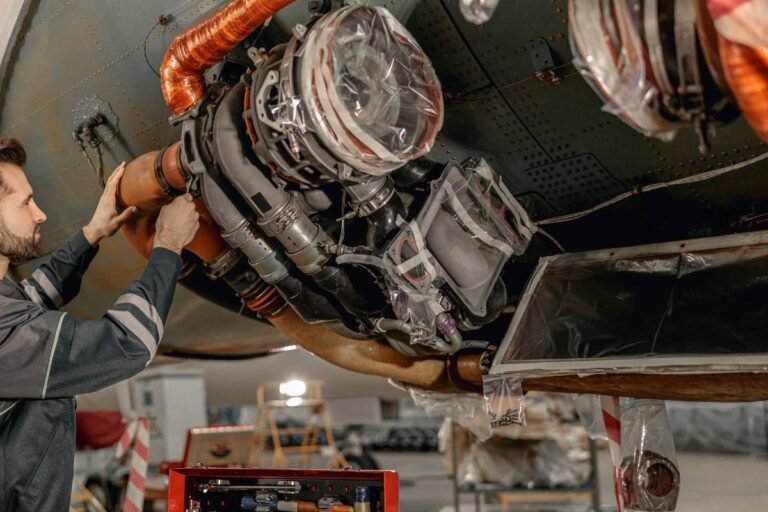
If you’ve started researching a career in aviation maintenance, you’ve probably run into a wall of confusing job titles. Aircraft mechanic. Aviation maintenance technician. AMT. A&P mechanic.
They’re all over job boards, school websites, and FAA documents, sometimes referring to the same person, sometimes not.
Here’s the short answer: aircraft mechanic and aviation maintenance technician (AMT) are the same job.
The titles are used interchangeably throughout the industry. But there’s enough nuance in how and where each term gets used that it’s worth clearing up before you start applying to programs or jobs.
This explainer breaks down what aircraft mechanic vs aviation maintenance technician actually means, where the terminology comes from, and what it means for you as someone exploring this career.
The FAA’s Official Language
Start with the source that matters most: the Federal Aviation Administration.
The FAA issues the certification that lets you legally work on aircraft in the United States. Their official term for it? The Airframe and Powerplant (A&P) certificate.
You won’t find the phrase “aircraft mechanic license” or “AMT license” in FAA regulations. The governing document, 14 CFR Part 65, uses “mechanic” as the job title and “Airframe” and “Powerplant” as the two certificate ratings you can hold.
So technically, if you’re going by the FAA’s language, you’re a mechanic with an Airframe and Powerplant certificate. That’s where “A&P mechanic” comes from, it’s just shorthand for someone who holds both ratings.
Where “Aviation Maintenance Technician” Came From
The term aviation maintenance technician, and the AMT abbreviation, came largely from the industry itself, not from the FAA.
Airlines, MRO facilities, and aviation trade organizations started preferring “technician” over “mechanic” because it better reflected the technical complexity of the work.
Think about what these folks actually do.
Modern commercial aircraft are sophisticated machines packed with avionics, fly-by-wire systems, composite materials, and computer-controlled everything. Calling the people who maintain them “mechanics” started to feel like an undersell. “Technician” communicates a higher level of technical skill, which, honestly, is accurate.
The Aviation Technician Education Council (ATEC) and other industry groups helped push this language forward. Many FAA-approved Part 147 schools, where you train for your A&P, now use AMT in their program names and marketing.
The military also standardized around “aviation maintenance technician” for certain occupational titles across service branches.
So AMT isn’t a different job. It’s a newer, more precise label for the same role.
How Employers Actually Use These Terms
Here’s the practical side. If you’re browsing job listings, you’ll see both terms, sometimes in the same posting. Here’s a general pattern of how they show up:
Airlines and large MROs tend to favor “aviation maintenance technician” or “aircraft maintenance technician.” Delta, United, American, their job postings almost universally use some variation of AMT.
It fits the professional, high-complexity environment they want to signal.
General aviation shops, FBOs, and smaller operators often stick with “aircraft mechanic” or “A&P mechanic.” Nothing wrong with that, it’s accurate and widely understood across the industry.
Government agencies and military contractors use both, but AMT is increasingly standard. Many GS position descriptions and DoD job postings have moved to “aviation maintenance technician” language in recent years.
FAA documentation and legal contexts use “mechanic” as the technical term. Your actual certificate will say “Mechanic, Airframe” and/or “Mechanic, Powerplant.” That’s the legal document; the job title is a separate thing.
The bottom line: the title on a job posting tells you more about the company’s sector and culture than it does about the actual job duties.
What About “A&P Mechanic”?
You’ll hear this one constantly, especially in general aviation circles and on trade forums. “A&P” is shorthand for the Airframe and Powerplant certificate. If someone says they’re an A&P mechanic, it means they’ve passed the FAA written, oral, and practical exams for both ratings and hold a valid certificate.
You can technically hold just one rating, Airframe only or Powerplant only, but in practice, almost everyone earns both.
Holding both opens you up to a much wider range of work and makes you significantly more employable.
Most Part 147 schools train you for both simultaneously, and most employers expect you to have both before you walk in the door.
You might also see IA mentioned, that stands for Inspection Authorization, an additional FAA privilege that lets certain A&P holders perform annual inspections and approve major repairs and alterations. It’s not a separate certificate, just an added endorsement.
To earn an IA, you need at least three years of active A&P experience, among other requirements. It’s a meaningful step up in responsibility and often comes with higher pay.
Does the Title You Use Actually Matter?
For most practical purposes, no, not really. Anyone who’s been in this industry for more than five minutes knows that “aircraft mechanic,” “AMT,” and “A&P” all refer to the same certificated professional.
Hiring managers aren’t confused by any of it.
That said, there are a few situations where being fluent in both terms is worth your attention:
Resume and application matching. If an airline’s applicant tracking system is filtering for “aviation maintenance technician” and your resume only says “aircraft mechanic,” you could get screened before a human sees your application. The fix is simple: mirror the language in the job posting.
Both terms are accurate, so use whichever one fits the context.
Talking to people outside aviation. “Aircraft mechanic” tends to land better with non-industry audiences, family, career counselors, HR staff from outside the field. It’s more intuitively understood.
Inside the industry, AMT signals you know the culture. Know your audience.
Military-to-civilian transition. If you’re coming out of military service where you held an AMT title, keeping that language in your civilian resume is appropriate and will be immediately recognized by employers who hire veterans. Don’t feel like you need to translate it.
One Distinction That Does Matter: Avionics Technicians
While we’re clearing up terminology, let’s address one title that actually is different: avionics technician.
Avionics technicians specialize in aircraft electronic systems, navigation, communication, flight instruments, autopilot systems.
They typically hold an FAA Avionics Technician certificate rather than the A&P. It’s a related field, but it’s a distinct career path with its own certification track, training programs, and job market.
If you’ve seen “avionics technician” in job listings and wondered if it’s the same as an aircraft mechanic or AMT, it’s not.
Worth knowing before you start applying to the wrong programs.
The Bottom Line
Aircraft mechanic and aviation maintenance technician are the same job with different names.
The FAA calls you a mechanic. The airlines call you an AMT. Everyone in the industry calls you both, interchangeably, depending on the context.
What actually matters is the A&P certificate: the FAA credential that qualifies you to work on aircraft, earn a professional wage, and build a career in one of the most durable and in-demand trades in the country.
If you’re ready to take the next step, explore AMT schools near you to see what FAA Part 147 programs are available in your area, and what it actually takes to get started.